Introduction
Most commercial buildings do not fail because of poor architecture.
They fail because of fragmented execution.
Across commercial projects, developers often appoint separate vendors for façades,
windows, glazing, railings, fire-rated doors, partitions, and automation systems.
On paper, this appears manageable.
On-site, it creates operational chaos.
The result is familiar across the industry:
- Delayed project timelines
- Escalation conflicts
- Water leakage
- Finish inconsistencies
- Structural coordination failures
- Increased maintenance
- Occupancy delays
- Tenant dissatisfaction
The problem is not individual products.
The problem is disconnected execution.
Modern commercial infrastructure requires integrated systems thinking.
What Is Integrated Fenestration Planning?
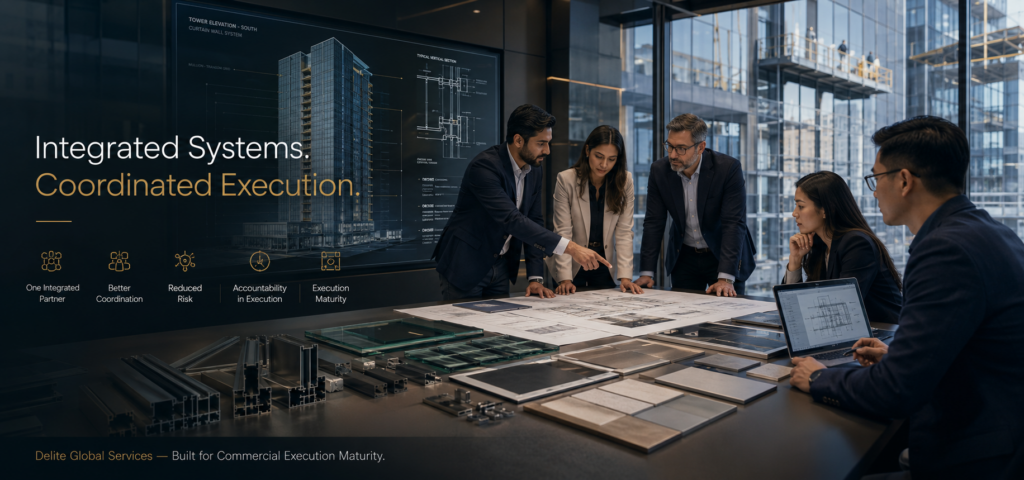
Integrated fenestration planning refers to the coordinated engineering and execution of all
architectural interface systems that impact the building envelope.
This includes: - Aluminium windows and doors
- Curtain wall systems
- Structural glazing
- ACP cladding
- Fire-rated doors
- Architectural railings
- Glass partitions
- Automation systems
- uPVC systems
Instead of treating these scopes independently, integrated planning ensures all systems
function together as one coordinated execution ecosystem.
Why Fragmented Vendor Ecosystems Create Commercial Problems
- Coordination Failure Becomes Inevitable
Commercial projects involve multiple stakeholders:
- Architects
- Structural consultants
- MEP teams
- Contractors
- Fabricators
- Site supervisors
- Installation agencies
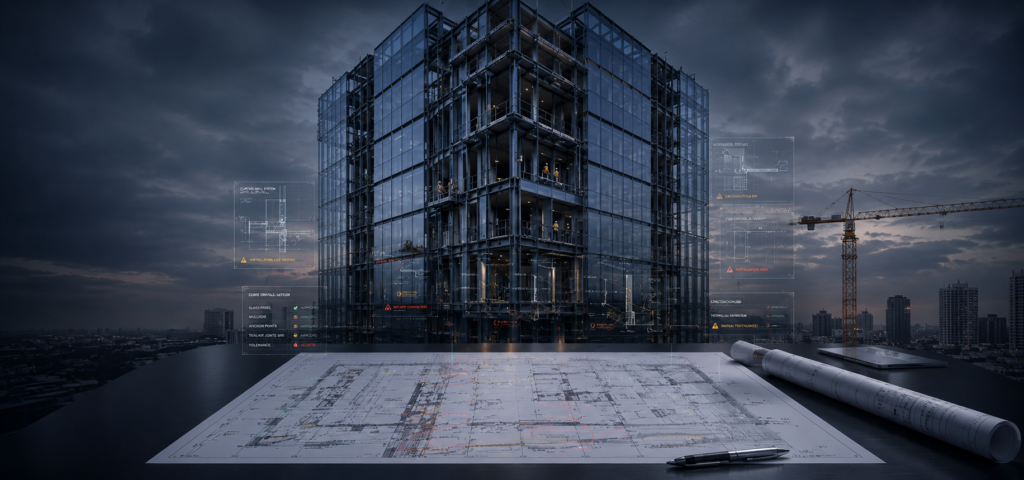
When every system is handled independently, execution alignment begins to collapse.
Common site-level problems include: - Incorrect opening dimensions
- Mismatched glass specifications
- Drainage detailing errors
- Delayed approvals
- Installation sequence conflicts
- Material compatibility issues
Every coordination gap eventually impacts: - Timelines
- Cash flow
- Occupancy schedules
- Developer reputation
- The Building Loses Visual Consistency
Commercial buildings require architectural uniformity.
Different vendors often use:
- Different profile geometries
- Different coating shades
- Different hardware standards
- Different fabrication methods
- Different glass specifications
The building gradually loses visual harmony.
This directly impacts project perception and commercial value.
- Long-Term Maintenance Costs Increase
Many commercial buildings begin facing operational issues shortly after handover because
systems were never engineered together.
Typical examples include:
- Water seepage
- Air leakage
- Sealant failure
- Corrosion
- Hardware malfunction
- Glass instability
The long-term maintenance burden frequently exceeds the initial procurement savings.
- Accountability Disappears During Crisis
One of the biggest commercial execution failures is responsibility fragmentation.
When problems arise:
- The façade contractor blames civil work.
- The installer blames fabrication.
- The glazing vendor blames the architect.
- The site team blames coordination delays.
The developer is left managing conflict instead of progress.
Why Developers Are Moving Toward Integrated Execution Partners
Commercial developers increasingly prefer integrated execution ecosystems because they
reduce operational uncertainty.
The benefits are practical:
- Better accountability
- Faster coordination
- Reduced site chaos
- Improved technical compatibility
- Faster communication
- Better lifecycle performance
- Lower maintenance risk
Commercial construction is becoming systems-driven rather than vendor-driven.
The Delite Global Services Approach
At Delite Global Services, we approach commercial projects through an engineering-first
mindset.
Our focus is not merely supplying products.
Our focus is reducing execution complexity.
We support: - Commercial developers
- Office infrastructure
- Hospitals
- Hotels
- Educational institutions
- Industrial projects
- Institutional infrastructure
through coordinated execution systems designed for long-term performance and
operational reliability.
Our Commercial Solutions Portfolio - Curtain wall systems
- Structural glazing
- Spider glazing
- ACP cladding
- Aluminium windows and doors
- uPVC systems
- Fire-rated doors
- Architectural railings
- Glass partitions
- Automated gate systems
The Future of Commercial Construction
The future of commercial construction belongs to: - Integrated systems
- Faster execution
- Engineering reliability
- Long-term durability
- Sustainability
- Better coordination
- Performance-driven infrastructure
Projects operating through fragmented vendor ecosystems will increasingly struggle with
operational inefficiencies.
Integrated execution ecosystems are becoming the future of commercial infrastructure.
Conclusion
Commercial buildings are long-term operational assets.
The quality of coordination behind the façade directly impacts: - Occupant comfort
- Operational continuity
- Maintenance costs
- Project reputation
- Lifecycle value
- Tenant experience
Integrated fenestration planning is no longer optional.
It is becoming a strategic competitive advantage.
The future of commercial construction belongs to integrated execution ecosystems — not
fragmented vendor chains.
Delite Global Services supports commercial projects through engineering-led, coordinated,
performance-driven execution systems designed for long-term reliability.